Chess Videos, Chess Forums and Global Chess Community
Drag to spin · tap to flip the pages
Share
Chess for People with 4 Hours a Week
$16.00
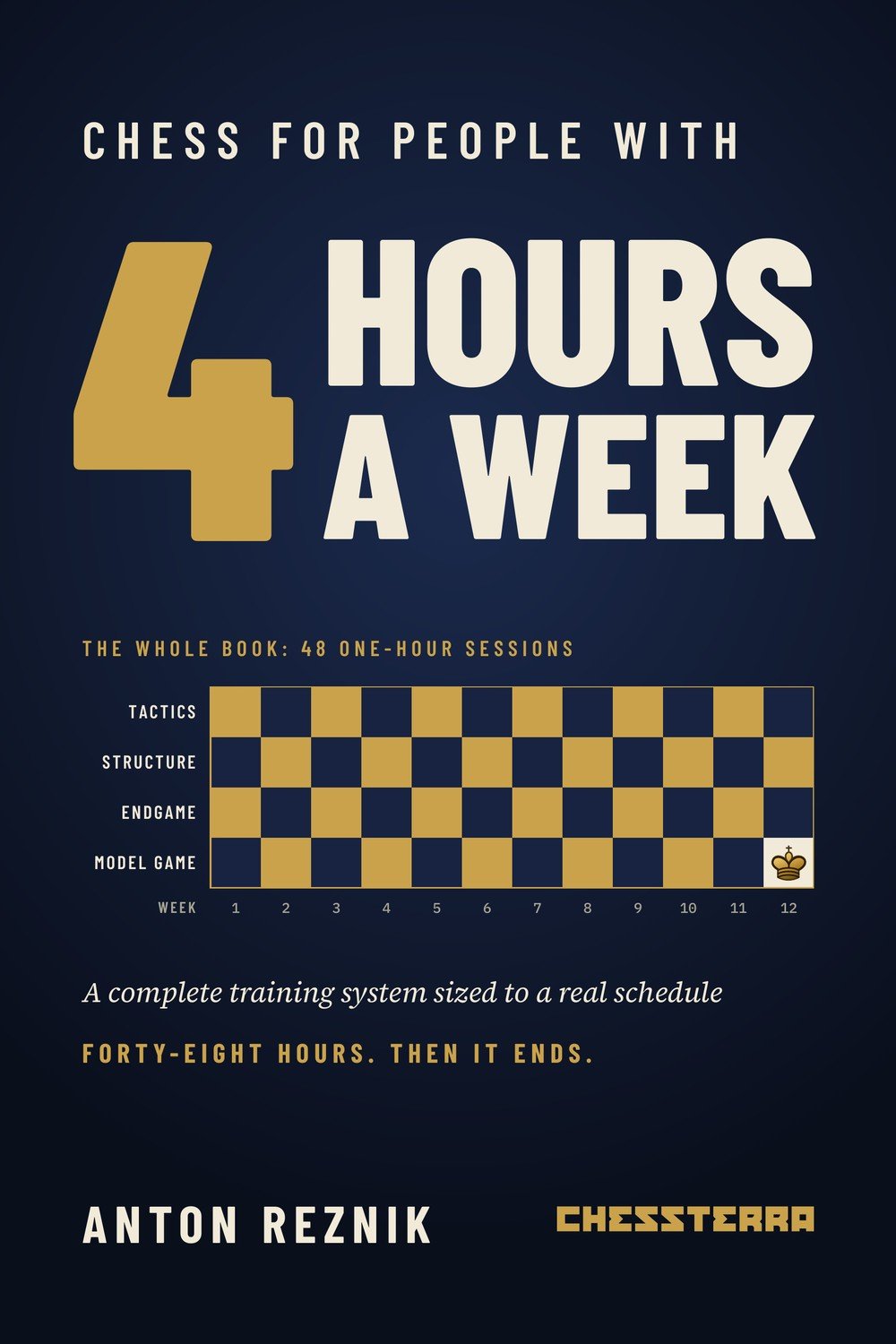
Most chess improvement books are written as if the reader had no job. This one is a twelve-week training system sized to four hours a week: one tactics set, one pawn structure, one endgame and one model game each week. Forty-eight one-hour sessions, and then the book ends.
By Anton Reznik. Paperback, 6 x 9 in, 220 pages. Printed to order and shipped to you.
Most chess improvement books are written as if the reader had no job.
They hand you a thousand positions or four hundred pages of annotated games and leave you to work out when you are supposed to get through it all. For most adults the answer is never.
This book starts from the other end. You have four hours a week, as a ceiling, in pieces that fit round everything else in your life. It gives the same answer to that every week:
Hour 1: Tactics. Eight positions from real games, all with the same pawn structure on the board. Five minutes each, pencils down at 40:00. Solutions are always over the page.
Hour 2: Structure. The plans for both sides in plain words, and the openings that lead there.
Hour 3: Endgame. One ending that structure leads to, the kind you must know exactly.
Hour 4: Model game. One great game played in it, with two or three places to stop and think.
Twelve weeks, twelve pawn structures: the open centre, the healthy majority, the isolated queen’s pawn, the Carlsbad, hanging pawns, the Caro–Slav, the French chain, the King’s Indian chain, the hole on d5, the open Sicilian, the Stonewall and the symmetrical centre.
Twelve endgames: the opposition, pawn races, Philidor, Lucena, rooks behind passed pawns, the rook’s pawn, good and bad bishops, queen against pawn, knight against bad bishop, triangulation, opposite-coloured bishops, and the last trade.
Twelve model games, from Morphy, Lasker and Nimzowitsch to Botvinnik, Smyslov, Petrosian, Fischer and Karpov.
And seven rules that make the book end. The hour stops when the timer does. Nothing carries over. Missed puzzles are not homework. There is no Week 13.
Inside: 96 tactical positions, 214 diagrams, a clock strip at the top of every session, a week log to fill in, and a season review in the last fifteen minutes of Hour 48. Every move was checked by software, the tactics and notes with the Stockfish engine, and the endgames against tablebases.
For players rated roughly 1000 to 1800 who know the rules, can read notation, and have lost a few games they should have won.
A ChessTerra book.
Reviews
There are no reviews yet.
Be the first to review “Chess for People with 4 Hours a Week” Cancel reply
Most chess improvement books are written as if the reader had no job.
They hand you a thousand positions, or four hundred pages of annotated games, and leave you to work out when you are supposed to get through it all. For most adults the answer is never. The book goes back on the shelf at page sixty, next to the others that stopped at page sixty.
This book starts from the other end. You have four hours a week. That is not four hours on a good week. It is four hours as a ceiling, in pieces that fit round everything else in your life. The question is what the best use of those four hours is, and this book gives the same answer every week:
one set of tactics, eight positions;
one pawn structure;
one endgame;
one model game.
One hour each. Twelve weeks. Forty-eight hours, and then the book ends.
Why these four
Tactics, because most games below master level are decided by them, and because it is the one skill that fades within weeks if you stop practising.
Structure, because it is the quickest way to know what to do when there is no tactic. Twelve pawn skeletons cover the great majority of positions that ordinary openings lead to, and each comes with a plan you can say in a sentence.
Endgames, because a small number of exact positions decide a large number of games, and unlike openings they never go out of date.
Model games, because a plan is easier to copy than to invent.
One subject a week
The four hours are not four separate subjects. Each week they are the same position seen from four sides.
Take Week 3. The tactics set is eight positions with an isolated queen's pawn on the board. The structure hour explains that pawn: what its owner is playing for and what his opponent is. The endgame hour teaches the rook ending that the pawn so often leads to. The model game is Botvinnik showing what to do with it. By the end of the week you have not studied four things for an hour each. You have studied one thing for four hours.
That is the reason the book can be short. Nothing in it is there to be complete. Everything in it is there because it connects to the other three hours of its week.
What is not here
No opening theory and no repertoire. No thousand-puzzle marathon. No chapters on psychology, on clock handling, or on analysing your own games. All of those are worth having, and none of them fits in the hours. Deciding what to leave out was most of the work of writing this book.
The cutoffs
Every hour ends after sixty minutes, whether you have finished or not. Every week ends after four hours. Nothing is carried over, nothing is made up, and nothing is added. The rules are set out in full two chapters from here, and there are only seven of them.
This is the part readers resist. It feels wrong to leave a puzzle unsolved or a page unread. But a plan that you complete with gaps is worth far more than a perfect plan that you abandon, and the cutoffs are what make this one possible to complete. They are the system. The chess is only what goes inside it.
What to expect
Forty-eight hours of honest work will not make anyone a master, and this book will not put a number on what it does for your rating. What it can promise is narrower and more useful.
At the end you will recognise twelve pawn structures on sight and know the plan for each side. You will know twelve endgame positions exactly, the ones that turn up most. You will have solved ninety-six positions properly, with a clock running, and played through twelve of the most instructive games ever played. For most club players, that is the difference between drifting through the middlegame and knowing what they are trying to do.
Who it is for
Anyone who knows the rules, can read chess notation, and has played enough games to have lost a few they should have won. In rating terms that is roughly 1000 to 1800, club or online. Below that range the harder tactics will be a stretch, and that is fine: the cutoff applies to them too. Above it you will know some of this already, and the hours will go faster.
Week 01Hours 1–4 of 48
The Open Centre
The pawns in the middle have been traded. Nothing is locked, nothing is slow, and the side with more pieces in play is in charge.
1
TacticsEight positions with a king or a loose piece on an open line
2
StructureOpen centre: development is the plan
3
EndgameKing and pawn against king: the opposition
4
Model gameMorphy – Duke of Brunswick and Count Isouard, Paris 1858
Before the first hour
Set up the pawns in the diagram on a real board and look at them for a minute. This is what is left when a 1.e4 e5 game opens up: one file swept clean and nothing to hide behind. Every position in this week's tactics set has a king that stayed in the middle too long, or a piece standing loose on an open line. Look for checks first.
This week's cutoff
One structure, one endgame idea. If the hour on the opposition makes you want to read about distant opposition and triangulation, write the words in the margin and leave them there. Triangulation has its own hour in Week 10.
Hour 1 · Tactics1 of 8
Kings on open lines
Eight positions, all from games in which the centre had been opened. Five minutes each at most. Decide on your first move, then turn the page.
1Black to move●○○
Solution 1Black to move
1...Bxf2+ 2.Qxf2 Rxf2 Black's rook has the f-file and f2 is attacked twice. The bishop takes with check and forks king and queen; Black wins the queen for a rook and a bishop.
Hour 1 · Tactics2 of 8
2White to move●○○
Solution 2White to move
1.Nf6+ Qxf6 2.Qxf6 A check that only the queen can remove. She takes the knight and is taken herself, because king moves are no better: 1...Kf8 2.Qh8+ Rg8 3.Qxg8#.
Hour 1 · Tactics3 of 8
3White to move●○○
Solution 3White to move
1.Ba3+ c5 2.Bxc5+ Kg8 3.Re8# The king on f8 has no air and the e-file is open. The bishop check forces a pawn to block, the bishop takes it with a second check, and the rook mates on e8. (1...Kg8 2.Re8# is a move quicker.)
Hour 1 · Tactics4 of 8
4White to move●●○
Solution 4White to move
1.Nxf7+ Kc7 2.Rxe8 The knight is the only thing standing between the rooks on the e-file. It leaves with check, and the rook on e8 falls.
Hour 1 · Tactics5 of 8
5Black to move●●○
Solution 5Black to move
1...Nf3+ 2.Kd1 Re1# White's knight is attacking a rook; Black's rook is aimed at an uncastled king. The knight check on f3 is double check, so the king has to move, and e1 is the mating square.
Hour 1 · Tactics6 of 8
6White to move●●●
Solution 6White to move
1.Rxd7+ Nxd7 2.Qxf4 Only the knight on f6 separates the queens on the f-file. The rook check on d7 drags it away. The king cannot take the rook, because the queen protects it.
Hour 1 · Tactics7 of 8
7Black to move●●●
Solution 7Black to move
1...Qxb2 2.Rd1 Bc3 3.Ne2 Bxd2+ White's queen was pinned along the diagonal from b4 to e1. Black keeps the theme and changes the piece: the queen takes on b2 with a threat to the rook, and after 2.Rd1 the bishop renews the pin from c3. The queen is lost.
Hour 1 · Tactics8 of 8
8White to move●●●
Solution 8White to move
1.Bxf7+ Qxf7 2.Rd8+ Kxd8 3.Qxf7 The king is still on e8 and the d-file is open. After the sacrifice on f7, the rook check at d8 pulls the king away from its queen.
60:00Write your score in the week log and stop. Missed puzzles are not homework.
HOUR 2 · STRUCTURE02 OF 48
Open centre: development is the plan
How to play when the middle of the board is empty.
00:00Read, with the pawns set up20 min
20:00Play through the examples25 min
45:00Check yourself15 min
60:00
What it is
An open centre is what you get when the d-pawns and e-pawns have been traded, wholly or in part. The commonest version is the one on the week's first page: White's e-pawn against Black's e-pawn, with the d-file swept clean. Trade the e-pawns as well and the middle is completely empty.
You reach it from almost every 1.e4 e5 opening in which somebody plays d4 or ...d5 and the pawns come off: the Scotch, the Italian with an early d4, the Philidor when Black gives up the centre, the Petroff, the Centre Game. It also turns up later in quieter openings, whenever a central break trades two pairs of pawns at once.
What matters here
Pawn structure usually tells you where to play. In an open centre it tells you when: now. There are no weak pawns to besiege and no chains to undermine. What decides the game is how many pieces each side has in play, and whose king is safe.
Count pieces, not pawns. Before every move in the first fifteen, count the pieces each side has developed. The old rule of thumb values three developing moves at a pawn. In an open position they are worth more than that.
Castle first. A king on e1 or e8 with the central files open is the target of the whole position. Castle before you do anything clever.
Open files belong to rooks. The first rook to reach the open file owns it. The second rook belongs beside the first, or on the next file to open.
A pawn costs time. Winning a pawn with the queen takes two or three moves: out, capture, and home again. In a closed position you can afford that. Here you usually cannot.
Bishops like it open. With no pawns in the way a bishop reaches across the whole board. If you can keep both of yours, keep them.
If you are ahead in development
Open more lines, and do it before your opponent castles. Offer a pawn if taking it costs him another move. Avoid trades unless the trade removes a defender. And bring the last piece into the attack before the final blow. Morphy's games are the proof, and you will play through one in Hour 4.
If you are behind
Give something back. Trade queens if you can: without queens, a lead in development is worth far less. Return the extra pawn if that gets your king castled. Block the open file with a piece that a pawn protects. And stop making pawn moves.
One file, one trick
The open e-file sets the same trap in a dozen openings. Here is the Petroff version, four moves deep.
After 1.e4 e5 2.Nf3 Nf6 3.Nxe5 Black is supposed to play 3...d6 first and take the pawn back a move later. If he takes at once, 3...Nxe4?, White answers 4.Qe2 and lines up queen and king on the same file.
The knight on e4 is attacked, and it must not move away.
The right reply is to let the knight go and win White's knight back with a pin, at the cost of a pawn: 4...Qe7 5.Qxe4 d6 6.d4. The natural reply, moving the attacked knight, is the last of your check-yourself questions below.
The endgame verdict
With symmetrical pawns and one open file, the heavy pieces tend to come off down that file, rooks first. A great many open-centre games end as king and pawn endings with one side a pawn up. That is Hour 3.
Check yourself
1. You are two moves ahead in development and your opponent has not castled. You can win a pawn, but it will take your queen two moves. Do you take it?
2. You are behind in development, your king is still in the centre, and you have the chance to trade queens. Do you?
3. White to move. What does the open e-file give him?
Check-yourself answersHour 2
1. No. The two moves are worth more than the pawn. Use them to open a file or bring up your last piece, and take the pawn when it costs nothing.
2. Yes. The attacker needs his queen far more than you need yours. With the queens off, a lead in development is rarely enough to do damage.
3.5.Nc6+, a discovered check from the queen. Whatever Black does, the knight takes his queen next move.
60:00Structure hour over.
End of the preview
The preview stops here.
That was half of Week 1. Hour 3 is the opposition, and Hour 4 is Morphy at the opera. Then eleven more weeks:



Reviews
There are no reviews yet.