This is a round 1 game from Norway Chess 2015 between Maxime Vachier-Lagrave and Levon Aronian. This tournament
Read more
Chess Videos, Chess Forums and Global Chess Community

1,167 videos tagged with this opening · Browse all chess openings
1.d4 d5 2.c41.d4 d5 2.c4 e6 3.Nc3 Nf6 4.Bg5 Be7 5.e3 O-O 6.Nf3 Nbd7 7.Rc1 c6 8.Bd3Play the Queen's Gambit as White. The bot answers with real book replies.
1.d4 d5 2.c4 e61.d4 d5 2.c4 c61.d4 d5 2.c4 e6 3.Nc31.d4 d5 2.c4 c6 3.Nf31.d4 d5 2.c4 dxc41.d4 d5 2.c4 e6 3.Nc3 Nf61.d4 d5 2.c4 c6 3.Nf3 Nf6 4.Nc31.d4 d5 2.c4 dxc4 3.Nf3Opening names and lines: Lichess opening database (CC0).
The Queen's Gambit is one of chess's oldest and most respected openings, arising after 1.d4 d5 2.c4. White immediately challenges Black's central pawn, offering it as a "gambit" — though it isn't a true gambit since the pawn can almost always be recovered. The Queen's Gambit chess opening signals a battle for central control from the very first moves, and it has been played at the highest level for over 150 years without ever going out of fashion.
The Queen's Gambit gained global mainstream attention through the 2020 Netflix series of the same name, introducing millions of new players to its elegant strategic concepts. With 1,167 instructional videos on ChessTerra.com, it's one of our most comprehensively covered openings.
The Queen's Gambit was played as early as the 15th century, appearing in the Göttingen manuscript of 1490. It became the defining opening of the classical era — Wilhelm Steinitz, the first World Champion, used it to demonstrate the power of positional chess. Emanuel Lasker, José Raúl Capablanca, and Alexander Alekhine all treated it as White's most principled first-move system.
In the 20th century, the Queen's Gambit Declined (QGD) became the battleground for World Championship matches between Anatoly Karpov and Viktor Korchnoi, and later between Karpov and Garry Kasparov. Today Magnus Carlsen, Ian Nepomniachtchi, and virtually every elite player carries it in their repertoire.
The Queen's Gambit produces some of the most instructive pawn structures in chess:
The solid, classical response. Black declines the pawn to maintain a solid pawn centre. Main lines include the Orthodox Defence (3.Nc3 Nf6 4.Bg5 Be7) and the Cambridge Springs (4...Nd7 5.e3 c6 6...Qa5). The QGD is the choice of players who want a solid, long-term positional battle.
Black accepts the pawn, planning to fight back in the centre with ...c5 and ...e5. White typically plays 3.e3 or 3.Nf3 to recover the pawn and gain a central advantage. The QGA leads to rich, active play for Black and is theoretically very sharp.
Black reinforces d5 with c6, preparing a solid position. The Slav is enormously popular — it avoids the "bad bishop" problem of the QGD while maintaining a solid pawn structure. The Semi-Slav (with ...e6) leads to some of the sharpest opening theory in existence.
Black immediately challenges the centre with ...c5, accepting the IQP in exchange for rapid piece development and active counterplay. Spassky and Korchnoi were great practitioners.
The Queen's Gambit chess opening is ideal for:
Downsides include:
This is a round 1 game from Norway Chess 2015 between Maxime Vachier-Lagrave and Levon Aronian. This tournament
Read more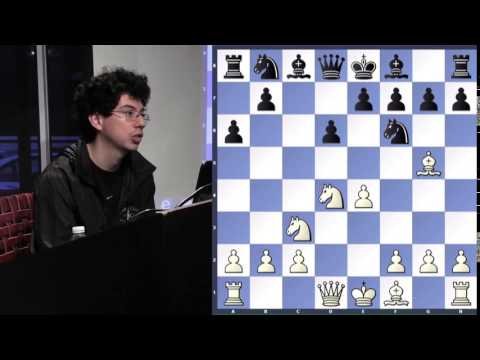
Grandmaster Alejandro Ramirez pays homage to Lev Polugaevsky, a multi-time World Championship candidate. One of the games even
Read more
Grandmaster Ben Finegold explores the wonderful world of fork tactics with games and examples. General rules are explained,
Read more
Grandmaster Ben Finegold profiles three-time USSR Champion Leonid Stein, one of the greatest ever to never become world
Read more
Grandmaster Ben Finegold pays tribute to former U.S. Champion Sam Reshevsky. Finegold adds humorous stories about Reshevsky and
Read more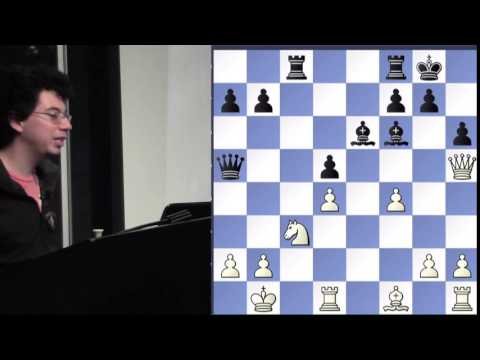
Grandmaster Alejandro Ramirez profiles the “Hero of Hastings” Harry Nelson Pillsbury. Pillsbury only played top level chess for
Read more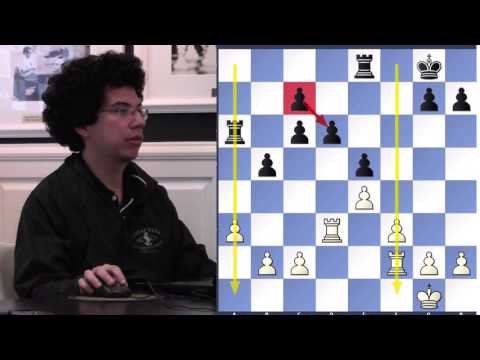
Grandmaster Alejandro Ramirez analyzes endgames from the third world champion, Jose Raul Capablanca. See the technique that gave
Read more
Mike Kummer stresses the importance of establishing a solid defense plan early by reviewing three games. One of
Read more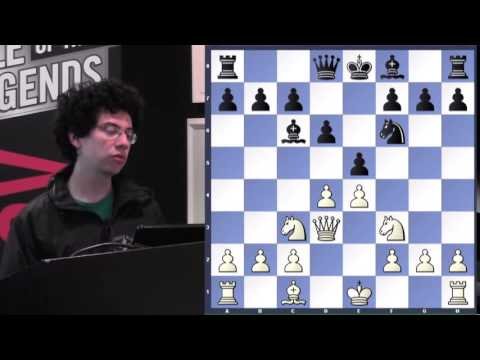
Grandmaster Alejandro Ramirez looks back to one of the strongest tournaments ever, St. Petersburg 1914. The dual-stage event
Read more
Grandmaster Alejandro Ramirez goes way back to the 19th century to learn from one of the game’s most
Read more