

Bobby Fischer
About Bobby Fischer
Robert James “Bobby” Fischer (March 9, 1943 – January 17, 2008) was an American chess grandmaster and the 11th World Chess Champion. A Brooklyn prodigy who became U.S. champion at 14 and a grandmaster at 15, he broke 24 years of Soviet dominance by beating Boris Spassky in Reykjavik in 1972, the most famous match ever played. He is widely regarded as one of the greatest players of all time.
Career highlights
- 11th World Chess Champion (1972–1975)
- Youngest U.S. Champion ever, at 14 (1957–58)
- Won all eight U.S. Championships he entered, including a perfect 11/11 in 1963–64
- Grandmaster at 15, the youngest in history at the time (1958)
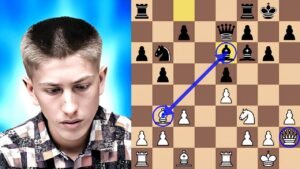
- “The Game of the Century” vs Donald Byrne at 13 (1956)
- Candidates 1971: 6–0 vs Taimanov, 6–0 vs Larsen, 6½–2½ vs Petrosian
- Peak rating 2785, 125 points clear of the world No. 2 (1972)
- Author of My 60 Memorable Games
- Inventor of the increment clock and Fischer Random (Chess960)
The life and career of Bobby Fischer
A Brooklyn prodigy
Robert James Fischer was born in Chicago on March 9, 1943, and grew up in Brooklyn, New York, raised by his mother, Regina. In 1949, when he was six, he and his older sister Joan worked out the moves from the instructions of a chess set bought at a local candy store. Joan soon lost interest. Bobby did not. Within a few years chess was the center of his life, and he was playing at the Brooklyn Chess Club, where Carmine Nigro gave him his first real instruction, and at the Manhattan Chess Club, the strongest club in the country. The coach and host Jack Collins opened his home and his large chess library to him, and Fischer read everything he could find, and even learned enough Russian to read the magazines of the Soviet players who ruled the game.
The Game of the Century
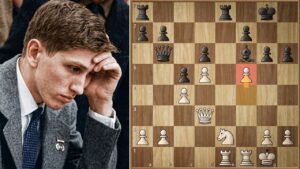
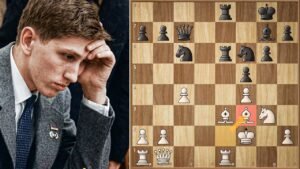
In October 1956, at the Rosenwald Memorial tournament in New York, the 13-year-old Fischer beat the strong master Donald Byrne with a queen sacrifice that led to a mating net of rooks, bishops and a knight. Hans Kmoch, writing in Chess Review, called it “The Game of the Century,” and the name stuck. The same year he won the U.S. Junior Championship. Then, at the 1957–58 U.S. Championship, he finished first without losing a game at the age of 14, still the youngest U.S. champion in history. He went on to play in eight U.S. Championships and won all eight, including the 1963–64 event, where he scored a perfect 11 out of 11 against the best players in the country, a result no one has matched.
His result at the 1958 Portorož Interzonal qualified him for the Candidates tournament and made him, at 15 years and six months, the youngest grandmaster in history up to that time. He dropped out of high school the next year to play full time.
The fight with the Soviet machine
From 1948 onward the world title belonged to the Soviet Union, whose players were supported by a state system of trainers, analysts and funding. Fischer, working largely alone, set out to break that hold. He won the 1962 Stockholm Interzonal by two and a half points, but at the Candidates tournament in Curaçao later that year he finished fourth. He then accused the Soviet players of agreeing quick draws among themselves to save energy for their games against him, and made the charge publicly in Sports Illustrated. FIDE later replaced the Candidates tournament with a series of knockout matches, a change widely seen as a response to his complaint.
The years that followed were marked by brilliant results and frequent walkouts over playing conditions, scheduling and money. In 1965 the U.S. State Department would not let him travel to Cuba for the Capablanca Memorial, so he played the entire tournament by teletype from the Manhattan Chess Club and still tied for second. In 1967 he was leading the Sousse Interzonal when he withdrew after a dispute over his schedule. In 1969 he published My 60 Memorable Games, still considered one of the most honest and instructive collections of annotated games ever written.
The greatest run in chess history
Fischer returned in 1970 in the best form any player has ever shown. He beat former world champion Tigran Petrosian in the USSR versus Rest of the World match in Belgrade, dominated a blitz tournament in Herceg Novi ahead of Mikhail Tal, and won the Palma de Mallorca Interzonal by three and a half points, finishing with seven straight wins. In the 1971 Candidates matches he beat Mark Taimanov 6–0 and Bent Larsen 6–0, two whitewashes against world-class grandmasters that have no parallel at that level. He then won the first game of the final against Petrosian, making it 20 consecutive wins against elite opposition, and took the match 6½–2½. On the July 1972 rating list he stood at 2785, 125 points ahead of the world’s second-ranked player, a lead no world number one has matched since.
Reykjavik, 1972
The world championship match against Boris Spassky in Reykjavik, Iceland, became the most famous chess event of all time, followed around the world as a Cold War contest between one American and the Soviet system. It nearly never happened. Fischer arrived late, lost the first game after grabbing a poisoned pawn in a drawn ending, and then forfeited the second game in a dispute over the television cameras, falling 2–0 behind. A phone call from U.S. Secretary of State Henry Kissinger and a doubling of the prize fund by the British financier Jim Slater helped keep him in Iceland. Game 3 was played in a small back room away from the cameras, and Fischer won it. In Game 6 he opened 1.c4, a move he almost never played, and won so beautifully that Spassky joined the audience in applauding. Fischer won the match 12½–8½ on September 1, 1972, becoming the 11th world champion and the first American-born player to win the official title. Chess boomed in the United States, and he was received as a national celebrity.
Forfeiting the crown
Fischer never played a competitive game as champion. For the 1975 title defense against Anatoly Karpov he demanded that the match be played until one player won ten games, with draws not counting, and that he keep the title if the score reached 9–9. FIDE accepted the first condition but not the second, and in April 1975 Karpov was declared world champion without a game being played. Fischer withdrew from public life, living quietly in California and turning down large offers to play again.
The 1992 rematch and exile
Twenty years after Reykjavik he reappeared to play Spassky again, in Sveti Stefan and Belgrade in Yugoslavia, for a $5 million prize fund. Fischer won 10 games to 5 with 15 draws, and the games showed much of his old strength. Because Yugoslavia was under United Nations sanctions, the U.S. government had warned him not to play. He spat on the warning at a press conference, and a warrant was issued for his arrest. He never returned to the United States. He lived in Hungary, the Philippines and Japan, and in these years he became known for bitter public statements, including antisemitic remarks and comments praising the September 11 attacks, which damaged his reputation badly. In 2004 he was detained in Japan for traveling on a revoked U.S. passport. Iceland, remembering 1972, granted him citizenship in March 2005, and he spent his last years in Reykjavik.
Bobby Fischer died of kidney failure in Reykjavik on January 17, 2008, at the age of 64, one year for every square of the chessboard. He is buried in a small churchyard at Laugardælir, near Selfoss in southern Iceland.
Style and legacy
Fischer played with a clarity that still reads as modern. He was not a romantic sacrificer by nature. He looked for the best move, played the Ruy Lopez and open positions with 1.e4, which he called “best by test,” and defended the Najdorf Sicilian, the King’s Indian and the Grünfeld as Black, often in their sharpest lines. His technique in simple positions, especially endgames with bishops, was so exact that grandmasters still study his games to learn how to convert small advantages. He also worked harder than almost anyone of his generation, and he treated every game, even blitz, as a battle to be won.
His influence reaches every chess player today. The increment clock he patented, which adds time after each move, is now standard in almost every serious game played over the board and online. Fischer Random Chess, the variant he introduced in 1996 with randomized back ranks, is now known as Chess960 or Freestyle Chess and has its own world championship and elite tour. His programmed-learning primer Bobby Fischer Teaches Chess is one of the best-selling chess books ever. His life has been told in books, documentaries and the 2015 film Pawn Sacrifice, and his games, from the Game of the Century to Game 6 in Reykjavik, remain the standard every champion since has been measured against.
Opening repertoire
Signature game
Bobby Fischer videos (1,344 total)