Get the complete course “Exchange Pieces like a Pro” – https://goo.gl/pRuvUM
The strategy of exchanges (or the exchange technique) in chess is very often underestimated by the young/inexperienced players. Of course, everybody likes to sacrifice, to play attacking and combinative chess, but we don’t always get such positions. That’s why it’s important to have almost all kind of weapons in our arsenal.
To better understand the concept of the piece exchange technique in chess, let’s say there are two pieces of equal value (say two bishops or two rooks), but it DOESN’T necessarily mean that they are actually ‘EQUAL’. What do I mean by this? Let me give an example.
Let’s say you have a knight that’s attacking your opponent’s pawn, and he protects that pawn with his knight. Even though you both have knights, that are equal in material (3 points), it doesn’t actually mean they are equal, positionally.
Because you have a knight that ATTACKS, whereas your opponent’s knight DEFENDS. An attacking /active piece is always better (or has better prospects) than its corresponding defending/passive piece.
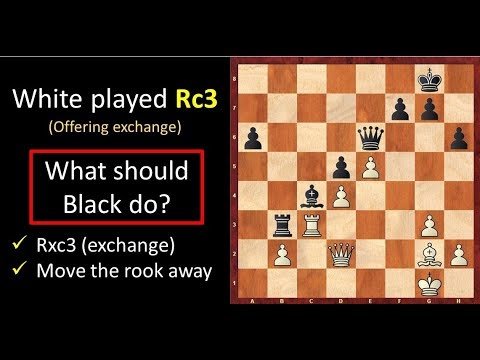
In this video GM Levan Aroshidze will teach when you to accept an exchange of pieces offer (or when to offer an exchange) and when not to exchange and keep your active piece in the game.
♕ 7 Best Chess Opening Traps (FREE course): https://goo.gl/WgKhBb
♕ Quick Success in Chess (FREE course): https://goo.gl/45Anbi
♕ Chess Training Plan for Rapid Improvement (FREE course): https://goo.gl/P68HZ6
♕ Chess Opening Fundamentals (FREE e-book): https://goo.gl/dj98ef
♕ Chess Courses and videos: https://goo.gl/WCPMGp